Originally posted by casino_king:
]My initial reading is that Buddha does not reject
"existence."[/b]
correct.
hence it's called:
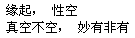
everything is yuan1 qi3 (exist dependent on something else, not
independent);
xing1 kong1 (the nature of everything is voidness,
as they are always changing). the key is the inside nature is kong,
not the outside.
Here is a useful maxim to remember the core concept of Sunyata
by:
Sunyata Affirms the Existence of Existence;
Sunyata Negates the Self-nature of Existence.
All teachings in the Tripitaka
(Buddhist Canon) are tools to induce sentient beings to sever
attachment. To those attached to Emptiness, Buddha Sakyamuni taught
Existence to break that grasp. To those attached to Existence, He
taught Emptiness so as to loosen that grasp. To those grasping at
both Emptiness and Existence, He taught "neither Emptiness nor
Existence" to break that grasp. Lastly, to those grasping at
"neither Emptiness nor Existence," He taught both Emptiness and
Existence to break that attachment. (1)
In short, the purpose is to draw all sentient beings away from
attachments. That is the Buddhist teaching of salvation. There is
no other way to return to the source [the Mind], though there are
many different expedient methods. We Buddhist students and
practitioners should not become attached to these methods. When
thoughts arise in our mind discriminating between what method is
right and what method is wrong, that is against the purpose of the
Buddhas and is a deviation from the Buddhist path.
For example, when Buddha Sakyamuni taught the Dharma of Emptiness,
His message was not that it was the opposite of Existence, but
rather that it was Truth and Reality. What are Truth and Reality?
Let me quote the T'ien T'ai Patriarch Chih I:
When one dharma is empty, then all dharmas are empty; there is no
separate Non-Emptiness. Without Non-Emptiness to contrast with
Emptiness, Emptiness itself is unattainable [i.e., does not
exist].
Similarly, when Buddha Sakyamuni taught Existence, this was not the
opposite of Emptiness, but was rather to say:
When one dharma exists, then all dharmas exist; there is no
separate Non-Existence. Without Non-Existence to contrast with
Existence, Existence itself is unattainable.
We should understand the true meaning of Emptiness and Existence.
Nothing we say about Emptiness or Existence is attainable (i.e.,
truly valid). And since this is so, why are we still attached to
them?
The Great Master Han-Shan thoroughly understood the goal of the
Buddhas. In tune with the minds of the Patriarchs, he spread the
Dharma (teaching), grasping at neither Emptiness nor Existence,
neither Non-Emptiness nor Non-Existence -- thereby manifesting the
Middle Way. Thus, he promoted the cultivation of both Zen and Pure
Land, pointing to the non-duality of Emptiness and Existence. That
teaching is "Wonderful Enlightenment" (see Glossary).
http://www.ymba.org/han/hanfrm.htm
/\


